

I was telling my girlfriend that the Polish have stolen many(!) words from the French language. The only examples I could come up with were mur (wall) and bilet / billet (ticket). My knowledge of french is poor and my polish worse. Can anyone else help prove my point?
Polish words shared with the french language
I'm French, i can help ;)
Actually the Polish language has borrowed words of many languages : German, English, French, Latin, etc.
;)
Actually the Polish language has borrowed words of many languages : German, English, French, Latin, etc.
;)
maybe you can give me just a few examples!
Ekran -> écran -> screen
Ekipa -> équipe -> team
Plaza -> plage -> beach
Szansa -> chance -> chance
Szef -> chef -> boss
Magazyn -> magasin -> store (shop)
...
;)
Ekipa -> équipe -> team
Plaza -> plage -> beach
Szansa -> chance -> chance
Szef -> chef -> boss
Magazyn -> magasin -> store (shop)
...
;)
thanks! can you think of any spelt exactly the same
...the problem is that the pronounciation wouldn't be the same, so generally there are words that come from French but written in a Polish way ;) Like in English...
But i think we can find a few words spelt the same like "Maître d'hôtel", but i don't think i know enough Polish...
But i think we can find a few words spelt the same like "Maître d'hôtel", but i don't think i know enough Polish...
The number of French words in Polish is not as large as it is in English, but still substantial.
The number of French words in Polish is not as large as it is in English
I agree, English has borrowed a lot of French words, particularly during the Norman era...William II -> Guillaume II
Yes, but they are so well assimilated into the language that 95% of the population are unaware that they come from French at all (war, wasp, warden, William: and all the words with an "s" in the place of the ^, all the names of meats: veal, mutton, pork, beef) - unlike expressions that are perceived as French like "carte blanche", "cul de sac", "coup de grace".
can you think of any spelt exactly the same
even if the sounds are almost the same, we still use the accent (stress) on the second last syllable (mostly), never on the last one like in French, so you always will hear the difference.
I think we have most borrowings from Latin and maybe German (from middle ages through all our history), later it was Italian (Renessaince), then French (Enlightment), finally English - it really depended on what country had the main cultural/political/economical influence on Europe (not only Poland). Other languages that borrowed us words are of course the ancient Greek, and less from Russian, Hungarian, Czech, Turkish and so on.
I'm not really an expert, so I won't go in details, because I may say something stupid :)
Yes, but they are so well assimilated into the language that 95% of the population are unaware that they come from French at all (war, wasp, warden, William: and all the words with an "s" in the place of the ^, all the names of meats: veal, mutton, pork, beef) - unlike expressions that are perceived as French like "carte blanche", "cul de sac", "coup de grace".
True, appart from the English who speak French, not many may know that a lot of words come from French...but for us, French, it makes the English language easier to learn thanks to the vocabulary
:)
ctually the Polish language has borrowed words of many languages : German, English, French, Latin,
It has taken a lot of words from Russian too.
I'm not sure of that.....the similarities that can exist come from the common roots of both languages i think...let me look for more info about it ;)
Oh, yes, the Poles have taken a lot of words, you only have to look at dom for a house czlowiek for a man morze for sea and moze for perhaps to see the similarities. The lists go on and on. The Poles are not proud of the fact and try to hid it but it is there clearly for anyone to see.
Dom......domicile in French, maybe common roots with Latin...
Morze...mer in French, may come from Latin too.....
;)
Morze...mer in French, may come from Latin too.....
;)
Oh, yes, the Poles have taken a lot of words, you only have to look at dom for a house czlowiek for a man morze for sea and moze for perhaps to see the similarities.
dom: an ancient, prehistoric word shared by many languages
French dôme dome
Italian duomo cathedral
Medieval Latin domus house
Greek domos house
Sanskrit dam
czlowiek:
In protoslavonic, the etymology of the word indicates "living in a group", and it is a composite denoting a descendant of a family.The word is protoslavic and is not regarded as a borrowing in any slavic languages. Some of the variants of the ancient word are:
lusatian - èłowjek
bulgarian - човек
croatian - èovjek
russian - человек
morze: even more ancient word shared by many languages
samudra - Sanskrit
more - Sebo-Croatian
morze - Polish
mora - Belarus
mare - Latin
mor (moroedd) - Welsh
mor - Breton
mar - Etruscan
The lists go on and on. The Poles are not proud of the fact and try to hid it but it is there clearly for anyone to see.
Hid? What? There is nothing to hide, as the following show:
Slownik Wyrazow Obcych (Dictionary Of Foreign Words) - swo.pwn.pl
Or this one? This is my actual dictionary, used a lot in yonder years, as the attached picture shows. There are 16,000 entries in it.
In all my years on basic levels of education, and then in various universities, I have never been acquainted with an idea of linguistic shame. All languages are influenced by, or influence other languages to a greater or lesser degree. See the English language, aka "the greatest borrower". Many languages stem form a common root, such as PIE, Old Slavonic etc.
Your post carries the usual attempt to pinch, venom towards anything Polish, and while spewing that venom you commenced a journey that has taken you beyond being a common liar. You are now officially on your merry way to making yourself a village fool of PF.
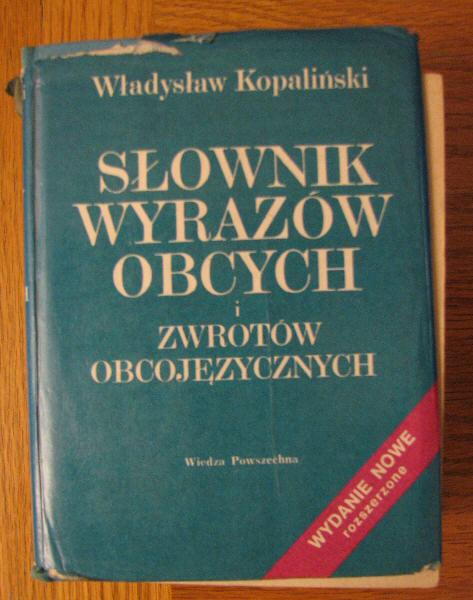
kopalinski.jpg
You are now officially on your merry way to making yourself a village fool of PF
I hope you don't mean me!
thanks for all your answers to my light-hearted post. I was hoping there would be more words in common and maybe it would make it easier for me to learn Polish.
thanks! can you think of any spelt exactly the same
a propos (there should be an accent over "a")
vis-a-vis (same as above)
savoir-vivre
Can't think of more examples - I think in most cases spelling was adjusted to Polish
True, appart from the English who speak French, not many may know that a lot of words come from French...but for us, French, it makes the English language easier to learn thanks to the vocabulary
I know English and French, both as foreign languages, and from my point of view French borrowings in English can sometimes make things easier - like, for example, I may understand new English words without having to check them because I know the French original. That's cool, but there is one serious drawback - it's next to impossible for me to pronounce a French borrowing in English if I learned that word in French first :D Like, I don't know - "bouillon" or "aubergine". The words, spelled like that, ARE French, it is natural for me to pronounce them the French way, and I need to stop and think if I try to pronounce them in English ;) Mind you, both are French borrowings in Polish also, spelled "bulion" and "oberżyna" :)
I hope you don't mean me!
No, don't worry, he only meant Michal ;)
I hope you don't mean me!
Not at all.
I think your post is a good one, and may actually help some learn a little more about the language.
both are French borrowings in Polish also, spelled "bulion" and "oberżyna" :)
We may find some French words in Polish cooking language...like in English and in many languages (-> purée...)
a propos (there should be an accent over "a")
vis-a-vis (same as above)
vis-a-vis (same as above)
With the accent : à propos / vis-à-vis...
;)
aubergine
Bakłażan not good enough?
Or does oberżyna have a slightly different meaning?
Bakłażan and oberżyna are synonyms. Like aubergine and eggplant?
Like aubergine and eggplant?
Eggplant is I think more of an American English term.
Solanum melongena - it's in the same genus as potato and tomato.
Brinjal is still used in some shops.
You know, you just made me google search for what language "bakłażan" could have originated from :)
I think that "bakłażan" and "oberżyna" mean the same thing, Solanum melongena, as you mentioned. The name brinjal originated from sanskrit and Arabic, if you can believe Wiki: en.wikipedia.org/wiki/Eggplant
OK, got it - I found that the Bulgarian and Russian words for aubergine are very similar to Polish "bakłażan". Again, if you can believe Wiki, it seems that "bakłażan" comes from a Turkish word which comes from Arabic. It's funny, because "aubergine" has originated from French, which originated from Spanish, which also originated from the same Arabic word :)
(and I found that by clicking on the Russian equivalent in the link above... I hope I got that right, since my Russian has not been used for many years and it was never very good in the first place)
I think that "bakłażan" and "oberżyna" mean the same thing, Solanum melongena, as you mentioned. The name brinjal originated from sanskrit and Arabic, if you can believe Wiki: en.wikipedia.org/wiki/Eggplant
OK, got it - I found that the Bulgarian and Russian words for aubergine are very similar to Polish "bakłażan". Again, if you can believe Wiki, it seems that "bakłażan" comes from a Turkish word which comes from Arabic. It's funny, because "aubergine" has originated from French, which originated from Spanish, which also originated from the same Arabic word :)
(and I found that by clicking on the Russian equivalent in the link above... I hope I got that right, since my Russian has not been used for many years and it was never very good in the first place)
if you can believe Wiki
I believe the Etymological dictionary I have, but only to a point.
The original meaning of the Sanskrit 'vatinganah' should be anti-fart vegetable.
This is not neccesarily how aubergines are understood today.
I believe the Etymological dictionary I have, but only to a point.
I wish I had one... As they say, "jak się nie ma co się lubi, to się lubi co się ma" (if you don't have what you like, you got to like what you have) :) Your dictionary is probably a more reliable source than Wiki, it's just that I was curious and Internet was all that I had.
The original meaning of the Sanskrit 'vatinganah' should be anti-fart vegetable.
This is not neccesarily how aubergines are understood today.
This is not neccesarily how aubergines are understood today.
:)
Which word is funnier - bakłażan or oberżyna?
I always found the word aubergine funny, especially when I was... that big.
Then, a Pole told me he finds bakłażan funny and has used it on many occasions as a sort of 'thingummyjig' word.
I always found the word aubergine funny, especially when I was... that big.
Then, a Pole told me he finds bakłażan funny and has used it on many occasions as a sort of 'thingummyjig' word.
I use "bakłażan", oberżyna sounds too foreign for my ears, while bakłażan is more assimilated in the Polish IMHO
kopalinski.jpg
We have this dictionary at home though I do not look at it at all.